Mining & Aggregates Freight Requirements
Every pit, mine and receiving plant sets its own procedure. These are the fields that decide whether a load is legal, admitted and paid.
Specifications
Mining and Aggregate Requirements at a Glance
Every pit, mine and receiving plant sets its own procedure. These are the fields that decide whether a load is legal, admitted and paid.
| Requirement | The specification | What it means for the load |
|---|---|---|
| Weight and axles | 80,000 lb gross on the Interstate system, 20,000 lb on a single axle and 34,000 lb on a tandem, with the federal bridge formula tying each group to axle spacing | Trailer type and axle configuration are chosen for the density, and placement is directed at the loader operator, because a dense load can pass on gross and fail on a group |
| Weighing and tickets | Certified scale weight before departure, with the pit ticket showing tare, gross and net tons | Material is invoiced per ton, so the scale ticket is the commercial document and it returns with the signed delivery paperwork |
| Site access | MSHA site specific hazard awareness training, 30 CFR Part 46 at sand, gravel and surface stone operations and Part 48 underground and at most other metal and nonmetal mines, plus site induction, PPE and gate procedure | Confirmed with the site before the first load, since a driver without the record does not leave the cab and the truck does not get loaded |
| Covering | Loose material contained and covered so it cannot leak, spill or blow off, sealed at the leading edge, with bagged and moisture reactive material protected from water | Fines blown off the deck are product lost, and spillage on a public road is a citation and, for concentrate, an environmental report |
| Moisture | Concentrate ships against a stated moisture content, while cement, quicklime, hydrated lime and treatment material are moisture reactive | Payable metal settles on dry weight, and quicklime reacts with water while cement and lime set, so water either costs on the assay or destroys the product |
| Securement | 49 CFR 393 securement with aggregate working load limit at least half the cargo weight, cribbing under concentrated point loads, inspection within the first 50 miles and every 150 miles or three hours | Dense loads bed in and go slack in the first miles, and a mantle or a liner set on a small footprint punches a deck that is legal on gross |
| Dimension | Giant OTR tires, mounted wheel assemblies, crusher shells and plant structure exceed legal height or width depending on how they are laid | The orientation is chosen deliberately against the route, then permitted for the dimension it takes, with escorts and travel time rules planned into the schedule |
| Classification | Reagents and blasting materials are classified before they are quoted: oxidizers such as ammonium nitrate, flotation reagents that can self heat, acids, and Class 1 explosives under their own carrier authorization | Classification decides the carrier qualification, the placards, the paperwork and the route plan, so it is settled before a truck is assigned |
| Export lots | Containerized concentrate and bagged mineral reach the box payload limit at roughly half its volume, and the shipper's verified gross mass has to be filed before the box is loaded aboard the vessel | The drayage leg is the constrained one, so chassis configuration and any overweight corridor permit are settled with the port before the booking is accepted |
The equipment
The Trailer Is Chosen by Density and Dimension, Not by What Is Closest
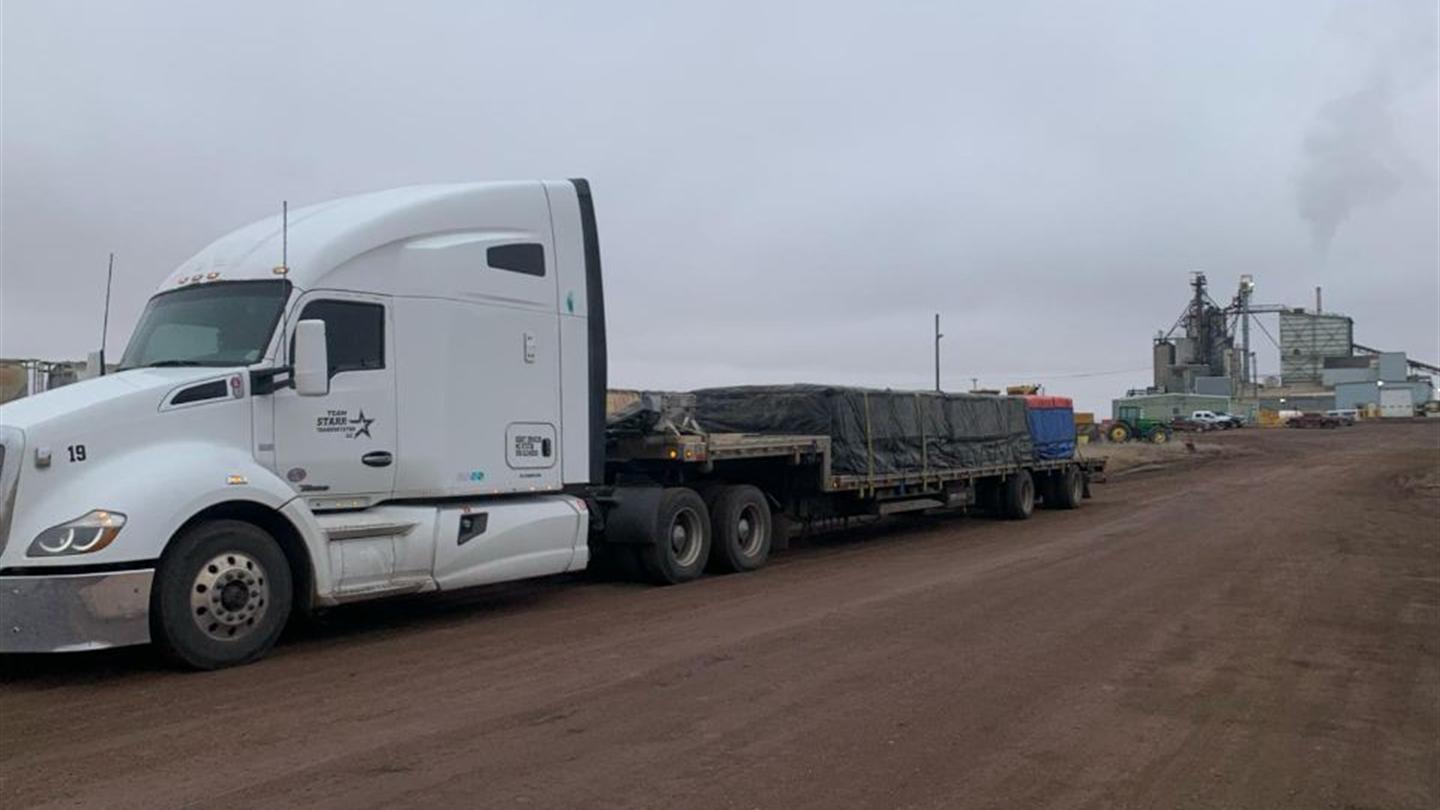
Dense bulk in super sacks and plant steel ride flatbed, with a spread axle trailer when the weight needs to be split across a wider group to stay legal. Anything tall goes to a step deck or an RGN to buy back the deck height that a giant tire, a crusher shell or a mill component eats. Palletized consumables, wear parts, grinding media and bagged material ride dry van, protected from weather and handled with a forklift at both ends. Export lots move in containers, where the box reaches its payload limit at roughly half its volume, so the drayage leg is the constrained one. Reagents are placed by classification, not by trailer. Two of those answers are modes rather than this industry, and they have their own pages: when a single piece goes over legal width, height or weight the move itself is an oversized load, with permits, escorts and travel time rules, and when a plant expansion or a crushing spread relocation arrives as many pieces in an erection sequence it is project cargo. The machines that dig and load at the pit, the excavator, the dozer and the wheel loader, move on the heavy equipment side of this operation. This page is the sector, those are the modalities it buys. What does not come off a general freight network is dedicated bulk equipment: end dumps, belly dumps, live bottoms and pneumatic tankers are specialized trailers tied to how the receiving plant takes material, and availability on your lane is confirmed with operations before it is ever quoted.
Get a Free, No-Obligation Quote Today
A logistics specialist reviews your lanes and comes back with pricing and capacity. Support runs 24/7.
Every carrier is vetted for operating authority and insurance, and we check the certificate before every dispatch, not once a year. USDOT 3411782 · MC 1100274