
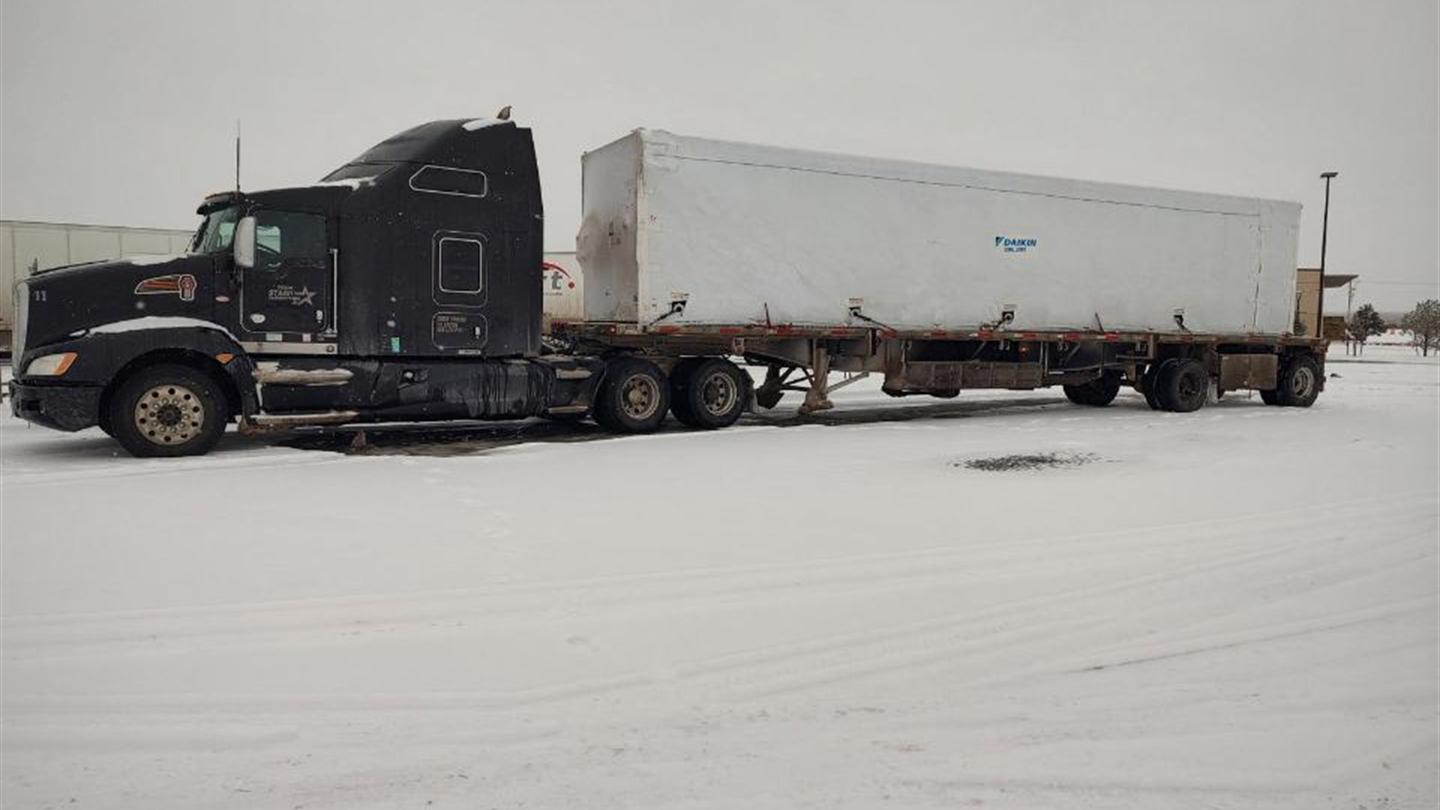
Full Truckload Freight: One Trailer, One Load, One Handling
Your freight loads at your dock, the seal goes on, and the doors stay shut until the receiver. No terminals, no cross-dock, nobody else's pallets stacked on yours. Dobie coordinates FTL capacity across all 50 states and into Mexico.
What is FTL, full truckload freight?
Full truckload is a shipment that takes an entire trailer. Your freight is the only freight on it. It loads at your dock, the seal goes on, and it runs direct to the receiver without passing through a terminal or transferring to another trailer. The standard unit is a 53-foot dry van: 26 standard 48 by 40 pallets on the floor, and roughly 42,000 to 45,000 pounds of payload once the tractor and trailer come out of the 80,000-pound federal gross limit.
Freight That Belongs in a Full Truckload
- Palletized consumer goods, 24 to 26 pallets a load
- Packaged food and beverage on a standing weekly lane
- Light, bulky freight that classes high in LTL: foam, packaging, insulation
- Retail replenishment shipping against an on-time-in-full receiving window
- Electronics, appliances and medical devices that should never see a cross-dock
- Cabinetry, millwork and flooring that fill the deck before they fill the scale
- Crated machine components and industrial parts, dock loaded at both ends
- Store fixtures and trade show freight, out and back as one sealed unit
- Palletized freight crossing into Mexico that stays in the same trailer south of the border
Who Ships Truckload
- Shipping managers moving 12 or more pallets at a time
- Brands whose light, bulky product gets punished by LTL freight class
- Suppliers facing a chargeback when a receiving window is missed
- Companies that already ate a damage claim at an LTL cross-dock
- Plants that would rather load a dropped trailer than hold a driver on the clock
- Exporters who want one trailer and one seal from their dock to a Mexican plant
FTL Wins on Risk and on the Clock Before It Wins on Volume
A full truckload loads once and unloads once. In between, the doors stay shut behind a numbered seal. The same freight moving LTL is loaded on a city pickup truck, unloaded at the origin terminal, reloaded onto a line-haul trailer, unloaded again at a breakbulk, then loaded a final time for delivery. Five touches, and a forklift operator at every one of them who has never seen your product before.
The clock works the same way. A truckload runs against hours of service: 11 hours of driving after 10 consecutive hours off, inside a 14-hour on-duty window, which puts a solo driver at 500 to 600 miles a day with no dwell in the middle. Published LTL transit is that same drive time plus the nights your pallets spend on a terminal floor waiting for the trailer going their direction to fill.
Where the Math Turns, Counted in Pallets
Below about six standard pallets, LTL is cheaper and you should ship LTL. Two pallets on a 900-mile lane with a flexible delivery date have no business taking a whole trailer, and neither does a single crate under roughly 2,000 pounds. You will hear that from us instead of a truckload quote.
Six to twelve pallets is the range where you quote both, and where partial truckload often beats each of them. It is also where LTL turns on you: most carriers apply a linear foot rule, and once your freight occupies about 12 linear feet of trailer, with some tariffs now triggering at 8 to 10, they re-rate the shipment at truckload-style pricing anyway. The cubic capacity rule does the same thing to light freight, typically once a shipment passes roughly 750 cubic feet at under 6 pounds per cubic foot.
Past twelve pallets, or roughly 15,000 pounds, FTL is usually the cheaper invoice outright. LTL prices off the NMFC freight class, which is driven mostly by density, so light bulky product classes high and pays for space it never weighs. What we will not do is book two half-empty trailers a week when one full trailer moves the same freight on the same lane.
Why Six Pallets of Fragile or High-Value Freight Still Ride Alone
Price is not the only number on the page. LTL carriers cap their liability by the pound under their published tariff, and the cap follows the freight class, not what the product is worth. A pallet of medical devices crushed at a cross-dock recovers a fraction of its invoice value, and the claim runs for months while you rebuild the order at your own cost.
Stacking is the other half. On an LTL trailer your pallets share the deck with whatever else is going that direction, loaded to fill the cube, and a pallet of glassware gets whatever the loader decides to set on top of it. In a dedicated trailer the load is braced for your freight alone: load bars behind each row, dunnage bags in the voids between pallets, nothing on top that you did not put there.
What Fits, and Which Ceiling Stops You First
A 53-foot dry van takes 26 standard 48 by 40 pallets in a single floor row, 52 if the product stacks safely. That is the cube ceiling. Weight is a separate one: 80,000 pounds gross, minus roughly 32,000 to 35,000 pounds of tractor and trailer, leaves about 42,000 to 45,000 pounds of payload.
Density decides which ceiling stops you. Freight under about 13 pounds per cubic foot fills the trailer with thousands of pounds of capacity unused. Dense freight does the opposite, and that is where truckloads get built wrong. Twenty pallets of tile weighs out at half a trailer, and loaded tight against the nose it pushes the drive axles past 34,000 pounds while the trailer tandems ride light. Sliding the tandems forward recovers only so much before the slide runs out of holes. A legal gross weight distributed badly is still an illegal truck at the scale, and the fix belongs on your dock, not at the scale house.
What the Lane Needs From Your Dock
Free time is commonly two hours to load and two to unload, then detention starts accruing by the hour. Nothing absorbs it the way a terminal schedule absorbs a late LTL pickup: that trailer and that driver are committed to your load alone, and every hour spent at your dock comes out of the same 14-hour window the driver has to reach the receiver.
Decide live load or drop trailer before booking, not the morning of. A drop trailer lets your crew load across a full shift instead of a two-hour window, and it exists only where the assigned carrier has a trailer to leave on your lane. The bill of lading needs the commodity, the piece and pallet count, the weight and the seal number, and we need the receiver's appointment rules at booking, because a consignee that only unloads truckloads between 6 and 10 a.m. changes what time the driver has to roll.
Full Truckload Specifications
The numbers a truckload is planned against before anyone quotes a lane.
| Standard unit | 53-foot dry van, roughly 99 inches of usable width and a 105-inch door opening |
|---|---|
| Pallets per trailer | 26 floor loaded in one row, 52 when the freight stacks safely |
| Usable payload | Roughly 42,000 to 45,000 lbs after tractor and trailer tare |
| Weight limits | 80,000 lbs gross, 34,000 lbs per tandem, steer usually capped near 12,000 by tire rating |
| Cube out or weigh out | Under about 13 lbs per cubic foot the trailer fills before it weighs |
| Handling | One load, one unload, doors closed in between |
| Seal | Numbered at loading, written on the bill of lading, read back at delivery |
| Free time | Commonly two hours each end, then detention accrues |
| Solo transit | 500 to 600 miles a day under the 11-hour driving limit |
| Team transit | Roughly double the daily miles, same trailer, same seal |
How a Truckload Gets Built
Send the Load Profile, Not Just the Weight
Commodity, piece and pallet count, pallet footprint, whether it stacks, dock or forklift at both ends, live load or drop. Stackability alone decides whether 26 pallets fill the trailer or 52 ride in the same 26 floor spots.
The Payload Gets Specced Before a Truck Is Assigned
Total weight against tractor and trailer tare, how that weight will sit across the axles, pallet height against a 105-inch door opening, dry van or temperature controlled. If the load runs past legal payload or past legal height, you hear it at quoting, not at the scale.
Loaded, Sealed, Documented
Operating authority and insurance are verified the day the carrier is assigned, with limits that match the load. The numbered seal goes on as the doors close and its number goes on the bill of lading, and inside the van the freight is braced with load bars behind the rows and dunnage bags in the voids, so the pallets arrive standing where they were loaded.
Direct Run, Documented Delivery
No terminals and no re-handling between the two docks. The driver runs to the receiver's appointment, the seal number is read back against the bill of lading before the doors open, and the signed proof of delivery closes the file.
Dry Van, Reefer or Deck: Same Truckload, Different Trailer
A truckload is a commercial arrangement, not a trailer type: the whole trailer is yours for the trip, whichever trailer it turns out to be. Most FTL freight rides in a 53-foot dry van, the default when the load is palletized and both ends have a dock. Temperature-controlled product moves the same dedicated way in a reefer, with two trade-offs to plan for: the insulated walls narrow the interior and the nose has to stay clear for the return air chute, so a 53-foot reefer often loads 24 pallets rather than 26, and the reefer unit and the heavier trailer take a few thousand pounds out of usable payload. Freight a forklift has to load from the side or over the top does not belong in a van at all, and moves flatbed or step deck instead.
Who Ships Full Truckload
Each of these ships this way for a different reason. The reason is what decides the plan.
Frequently Asked Questions
How many pallets is a full truckload?
A 53-foot dry van holds 26 standard 48 by 40 pallets in one floor row, or 52 double stacked when the product carries weight on top. A 53-foot reefer usually holds about 24, because the insulated walls narrow the interior and the return air chute needs the nose kept clear.
At how many pallets does FTL beat LTL on price?
Under six pallets, LTL almost always wins. Six to twelve is where you quote both plus partial truckload. Past twelve pallets, or about 15,000 pounds, FTL is usually cheaper outright, and the linear foot rule often re-rates the shipment at truckload pricing before you even get there.
How much weight can one truckload carry?
Plan on 42,000 to 45,000 pounds. The 80,000-pound gross limit is shared with the tractor and trailer, and the load still has to sit inside 34,000 pounds per tandem, with the steer axle usually capped near 12,000 pounds by its tire rating. Past that you are into overweight permits and different equipment.
Is the trailer sealed?
That is standard truckload practice and it is worth writing into the booking. A numbered seal goes on as the doors close at your dock, the number goes on the bill of lading, and the receiver reads it back before opening the doors. Nothing is added or removed in between, because there is no terminal in between.
How fast does a truckload move?
A solo driver covers 500 to 600 miles a day inside the 11-hour driving limit that follows 10 consecutive hours off. Two drivers on the same trailer roughly double that, because the trailer keeps rolling while one sleeps. Either way the run is direct, so the transit carries no terminal dwell.
Can my crew load the trailer over a full shift?
That is a drop trailer, and it depends on whether the assigned carrier has one to leave on your lane. When it works you load on your own clock and skip detention entirely. When it does not, plan the live load around the two-hour free time and have the paperwork ready before the driver backs in.
Last reviewed: August 2026 · Reviewed by the Dobie Transport logistics team
Get a Free, No-Obligation Quote Today
A logistics specialist reviews your lanes and comes back with pricing and capacity. Support runs 24/7.