In short
Metals freight is the load that reaches the legal weight limit before it fills the trailer, every single time. One hot rolled coil can weigh what a whole trailer of packaged goods weighs, and it concentrates that weight into a few feet of deck instead of spreading it across forty eight. So the question stops being how much fits and becomes where each piece sits, what keeps it from rolling and what holds it down. Federal securement rules pull metal coils out as their own commodity class, with a tiedown arrangement keyed to which way the eye is pointing. Steel starts oxidizing the moment water reaches it, pipe threads bruise if a chain lands in the wrong place, and a load that is legal on the gross scale can still be over on one axle group. All of that is decided at loading, not discovered at the destination.
Metals Weigh Out Before They Cube Out
A tractor and a flatbed leave you somewhere in the mid forty thousands of pounds of legal payload against the 80,000 pound interstate gross limit. One hot rolled coil can eat most of that by itself. Two of them and the truck is loaded, on a deck that still looks empty from the shoulder. That single fact drives everything else about this freight: you are never filling space, you are placing weight.
Placement is where metals loads actually get in trouble. Federal limits are not just a gross number, they are 20,000 pounds on a single axle, 34,000 on a tandem group, a steer axle capped by tire rating and state law, and the bridge formula tying allowable weight to how far apart the axles sit. A concentrated article like a coil or a bundle of billets parked three feet too far back puts the trailer tandems over while the gross reading is perfectly legal. Nothing about the ticket looks wrong until the scale prints the axle breakdown.
Then it is a problem you cannot solve on the shoulder. Sliding the tandems buys a few thousand pounds of transfer, and after that the coil has to be lifted and moved, which takes a crane that does not exist at a weigh station. Some states add their own geometry on top, like the kingpin to rearmost axle limit that forces a different load position on a truck routed through California. Steel is a divisible load, and states do not permit around an overweight divisible load, so there is no ticket you can buy at the counter. The fix has to happen at the mill.
So the plan starts with a piece list: weight per coil, per bundle, per lift, and the dimensions of each. From that the load is built with positions assigned before the crane operator picks the first piece, which is the difference between a truck that clears the scale house and a truck that sits in it. Total tonnage tells you nothing here. Twenty thousand pounds spread across ten bundles and twenty thousand pounds sitting in one coil are two completely different load plans.
Coils Have Their Own Rule in the Federal Securement Standard
The federal cargo securement rules carve metal coils out as a separate commodity with their own requirements once the coil or the group weighs 5,000 pounds or more. The reason is simple physics. A coil is a dense cylinder with its mass on one axis, it wants to roll, and once it starts moving nothing on a flatbed reverses it. The rule turns on eye orientation: eye vertical, eye crosswise to the trailer, or eye lengthwise toward the front and rear.
Each orientation gets its own arrangement. A coil with the eye lengthwise takes tiedowns through the eye arranged to restrain it forward and rearward, with blocking where the rule calls for it. A coil standing eye vertical takes tiedowns criss-crossed through the eye plus a tiedown over the top, so the coil cannot tip and the wraps cannot walk apart. In every orientation the coil has to sit in something that removes the possibility of rolling: a coil rack, a purpose built cradle, or timbers and chocks positioned and secured so they cannot slide out from under the load. This is why the orientation you load in is a dispatch question, not a detail. A truck rigged for eyes crosswise is not automatically rigged for eyes vertical.
On top of that the general rules still apply. Aggregate working load limit has to reach at least half the weight of the article, so a heavy coil is counted in chain, not guessed at. Chain is the normal choice on steel because a sharp plate edge or a snapped coil band will cut synthetic webbing under tension, and corner protection goes anywhere a tiedown crosses an edge. Aluminum and coated product flip that logic, taking webbing and non-marring dunnage instead, because a chain laid on a bare extrusion leaves a mark that scraps the piece.
Steel also settles. Timbers compress, the load beds into the dunnage, and chain that was tight at the mill is slack twenty miles later, which is exactly why the driver has to inspect and re-tension inside the first fifty miles and then at set intervals through the trip. None of this happens on a truck that shows up without a coil package, so the assignment names the equipment: rack or cradle, timbers, chain count against the piece weights, edge protection and steel tarps physically on board before dispatch.
Pipe, Structural and Bundles: Rolling, Threads and Length
Pipe is the other cargo on this list that rolls, and the rule for anything likely to roll is the same: chocks, wedges, a cradle or an equivalent that removes the movement rather than resisting it. Rows stack in a pyramid with the bottom row blocked into the stake pockets and dunnage strips between layers, because a bottom row free to shift takes the whole stack with it. Mill banding holds a bundle together, it is not securement, and every bundle on the deck gets its own tiedowns counted against its own weight.
On threaded pipe the threads are the expensive part of the joint. Casing and tubing ship with protectors on both ends, and the protectors stay on through loading, transit and unloading. Chain never lands on a thread, joints do not get dragged across the deck, and the ends are kept off bare steel. A bruised or galled thread does not fail visibly at delivery, it fails at the rig floor or on the fabrication line when the joint will not make up, and by then the joint is scrap or a recut.
Length is the third variable. A standard flatbed decks forty eight or fifty three feet, and product that runs past the trailer starts a different conversation: rear overhang has to be flagged and marked, states cap how far it can project, and past that the load moves on a stretch or extendable trailer under permit with the route checked ahead of it. Height works the same way. A tall bundle or a coil standing in a rack can put you against the thirteen foot six inch height most lanes are built around, which is what a step deck solves by dropping the deck, and an RGN handles the pieces that have to load off the rear or sit too tall for anything else.
One note on scope, because these get mixed up on a quote. This page is the sector. The trailer and mode pages are the how. A single piece that is over width or over height is an oversized move with permits, escorts and a surveyed route, and a fabricated multi piece shipment that has to land in erection sequence is project cargo. Metals freight uses both, but most of it is ordinary legal weight steel that simply has to be loaded correctly.
Rust Is Cargo Damage, and the Tarp Is Product Protection
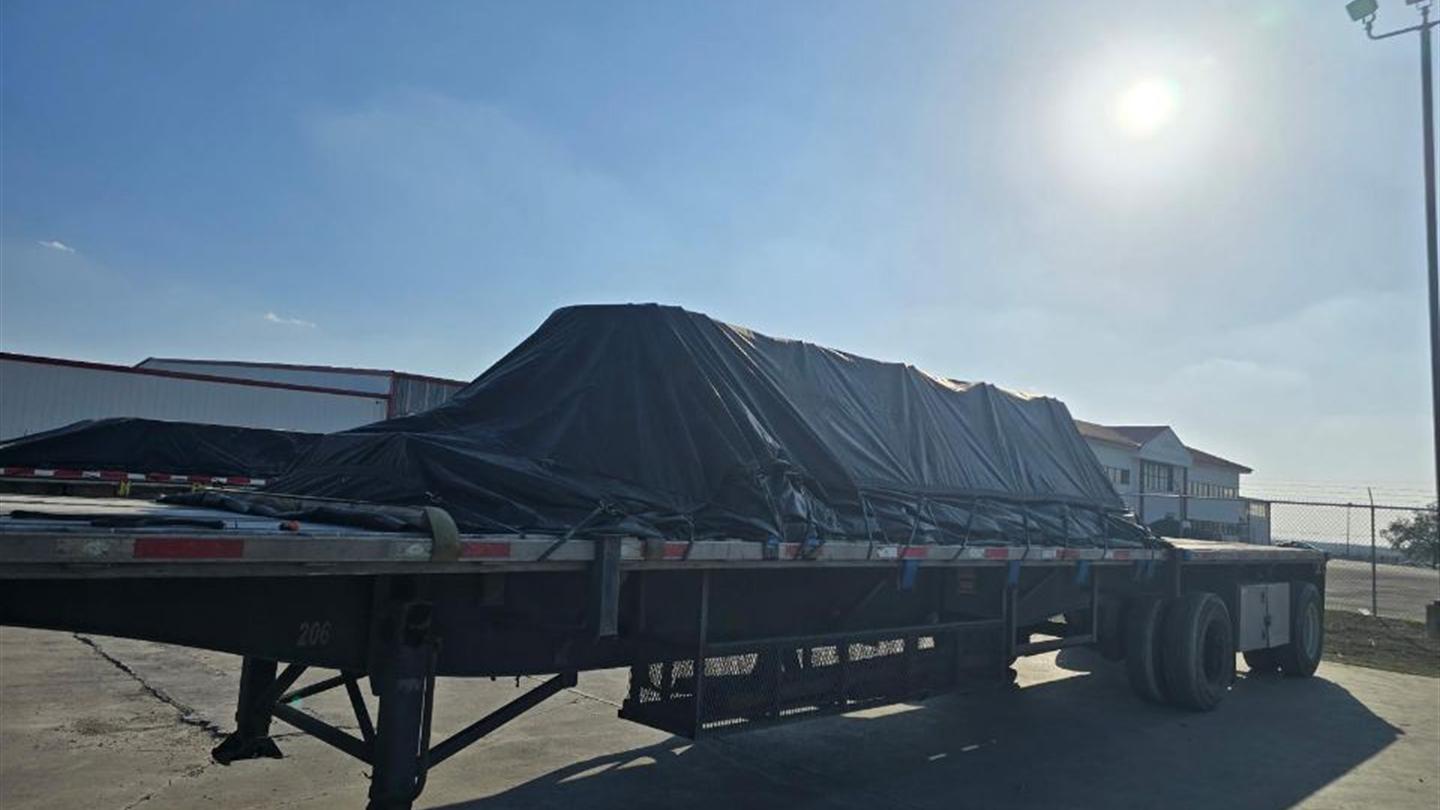
Tarping a steel load is not about how the truck looks. Bare steel starts oxidizing the moment water reaches it, and on cold rolled, galvanized or prepainted coil the surface is the product. Water that gets between the wraps of a coil stains inward and stays there, and galvanized product picks up wet storage stain, the chalky white corrosion that forms when moisture sits trapped against zinc with no airflow. A receiver buying that coil for an exposed or coated application does not sand it, they downgrade it or reject the whole coil.
Condensation does the same damage without a drop of rain. Steel loaded cold and driven into warm humid air sweats under the tarp, so product ships with its mill wrapping and its vapor corrosion inhibitor paper intact, and tarps go on tight rather than left to balloon, since a loose tarp at highway speed pumps air and water into the load all day.
The tarps themselves are specific. Steel tarps have a shorter drop than lumber tarps and are built for sharp edges, and corners get protection so a plate edge does not shred the tarp in the first hour. Tarping a coil load in weather is real work on the clock, which is why it belongs in the dispatch conversation and on the rate confirmation, not as something the driver discovers at the mill gate. If the load has to be tarped, that requirement travels with the assignment.

How a Metals Load Fails in Transit, and What Prevents It
The catastrophic failure is a coil that breaks loose. Nothing on a trailer absorbs that much mass in one lump, and a coil that gets moving in a hard stop goes through the headache rack. It is prevented at loading, not on the road: the correct pattern for the orientation, a cradle or chocks that make rolling impossible, working load limit that actually covers the weight, and the re-tension inside the first fifty miles once the load beds into the timbers.
The quiet failures cost more often. Mill bands snap on a bundle of bar or a wire rod coil and the pieces spread across the deck, and a strand of loose rod catches air and beats against everything near it. Forks and slings mark cold rolled sheet and aluminum extrusion, and a handling mark on surface critical product is a rejection even though the metal is sound. Plate that shifts scores the piece under it. Threads bruise from a chain laid in the wrong place.
Moisture is the failure that shows up as a claim weeks later, when the coil is unwrapped at the processing line and the stain is between the wraps. Condition documented at pickup and at delivery is what settles that argument, because the only question that matters is whether the product left the mill dry and arrived dry.
Then there is the axle violation, which is a failure even though nothing is damaged. The load is legal on gross, over on a group, and it sits at the scale until a crane can be arranged to move a piece. Non-ferrous adds theft to the list, since copper and aluminum resell by weight with no serial number to trace, so those loads warrant a recorded seal, no unsecured stop in the first hours out of the shipper, and a team on the truck when the value justifies keeping it moving instead of parked in an open lot.
Why Dobie Fits Metals, Steel and Pipe Freight
Dobie coordinates transportation: a vetted carrier network managed by dedicated logistics specialists. For metals that matters in a specific way, because this cargo fails when the truck that arrives is not the truck the load needed. The carrier assigned is verified the day it is assigned, not once a year on a file review: operating authority in force, cargo insurance current with limits that correspond to the load, and equipment that corresponds to the assignment. On a coil load, equipment that corresponds to the assignment means the rack or cradle, the timbers and chocks, the chain count checked against the piece weights, and the steel tarps physically on that truck, confirmed before it is dispatched to your gate rather than discovered under the crane.
The equipment range is the second reason. A nationwide network of vetted carriers across all 50 states, running a 98% on-time record, means one account can put a mill direct coil on a flatbed, a racked coil that no longer clears on a step deck, a long joint of line pipe on a stretch under permit and an overweight box of pipe on a chassis off the ramp, instead of forcing every order onto whatever equipment was set up for last month's shipment. Securement follows FMCSA standards. When a piece runs over legal dimension, permits, escorts and route planning are part of the job rather than a reason to say no. One dedicated specialist stays on the account, and support is 24/7 for the truck sitting at a scale house at ten at night.
The third reason is geography. Northeastern Mexico is a steel and pipe corridor, and product crosses in both directions through South Texas. The crossings, the customs brokers, the maneuvering yards and the carriers on the Mexican side are weekly business here, which matters on cargo where the paperwork is unusually specific: heat numbers and mill test reports have to stay attached to the material, and imported steel carries its country of melt and pour into the entry. Weight rules are not identical on the two sides of the line either, so the load gets built for the stricter leg instead of being restacked at the border. A crossing planned inside the delivery schedule beats a crossing discovered inside it.
There is also an internal team here that handles cargo other than vehicles and machinery, with experience in refrigerated freight, food and hazardous materials. On a metals program that shows up on the lanes around the steel: pickling acid, coating chemicals and solvents move under regulated paperwork, so those loads are quoted by people who already work that freight instead of by someone reading the shipping papers for the first time.