Energy & Renewables Freight Requirements
Each component family on the same project answers to different rules. These are the fields that decide equipment, permit and schedule.
Specifications
Energy Component Requirements at a Glance
Each component family on the same project answers to different rules. These are the fields that decide equipment, permit and schedule.
| Requirement | The specification | What it means for the load |
|---|---|---|
| Dimensions and clearance | Blades whose loaded combination passes 200 feet, base tower cans over legal height by diameter alone, enclosures over height on a standard chassis | Off-tracking, turning radii, overhead lines and structure clearances drive the route survey, which runs to the pad and not to the site gate |
| Weight and bridge capacity | Transformers concentrate mass on a short footprint, so a state's superload thresholds and per-structure bridge analysis apply | Axles are added to satisfy the bridge formula, and the engineering review is scheduled ahead of capacity because the permit is the long pole |
| Permits and escorts | State by state single trip permits, pilot cars, height poles, police assistance, utility line lifts, curfews and night only movement windows | Permit conditions are collected before dispatch and the travel plan is built around them, including which hours the load is legally allowed to move |
| Documentation | OEM transport manual, packing list with weights, dimensions and center of gravity, lift and saddle point drawings, impact recorder records | The transport manual is treated as the load spec and confirmed with the assigned carrier before loading, not read for the first time at the pad |
| Shock and vibration | Three axis impact recorders on transformers, shock and tilt indicators on module pallets, OEM thresholds that carry warranty consequences | Speed, braking, crossings and overnight parking are planned as part of the move, because the recorder chart is read at delivery |
| Hazardous materials | Loose lithium cells and modules as UN3480 and installed batteries as UN3481, both Class 9: UN 38.3 test summary, specified state of charge, short circuit protection, marks, papers, 24 hour emergency contact | A hazmat capable carrier is assigned and papers are verified at dispatch. Class 9 is not placarded in U.S. domestic highway transport, so marks, papers and trained personnel carry the compliance, and damaged or defective cells are handled as their own case |
| Handling and securement | Blades on manufacturer stations with straps over designated pads only, cable reels upright on the flange, enclosures lifted at labeled points and never dragged | Securement follows FMCSA standards plus the OEM's contact points, which are stricter than the regulation on composite and glass components |
| Delivery window and sequence | Crane mobilization dates, hub height wind limits on lifts, laydown yard capacity and an erection order that pieces must arrive in | Loads are released backward from the crane date and delivered into the sequence, so nothing is double handled in the yard |
| Site access | Gravel and caliche access roads, temporary culvert crossings, pad turnarounds and offload equipment that has to be on site to receive | The access leg is surveyed with the highway route, and speed on washboard road is treated as a damage control, especially with module pallets |
| Equipment | Blade trailers, multi-axle platform equipment, RGN and lowboy, step deck, flatbed, container chassis and dry van on the same project | Equipment is matched to each component's drawing, and the specialized configurations are confirmed against your component list before they are promised |
The equipment
The Component Picks the Trailer, Then the Route Confirms It
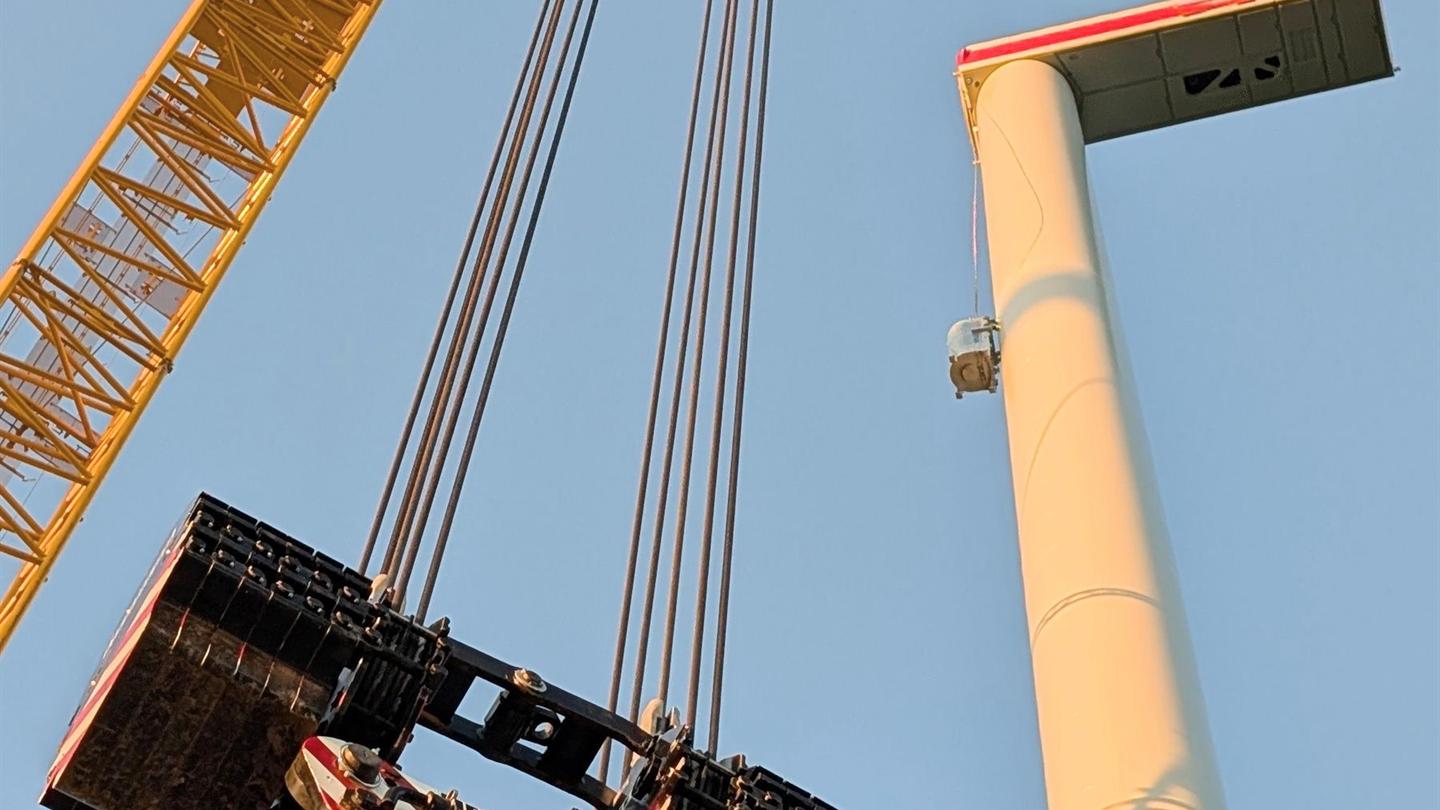
On an energy project the equipment decision is made piece by piece off a drawing. Tracker torque tubes, pile bundles, crated switchgear and cable reels ride flatbed, with the reels standing on the flange and blocked against rolling. Anything that loses its legal height on a flat deck, which includes most base tower cans and many battery enclosures, moves to step deck or drop deck. Drivetrain components and transformers that are still inside conventional heavy haul range go on RGN or lowboy, where the low deck buys back the clearance the height of the piece takes away. Past that range the answer is multi-axle hydraulic platform equipment spread wide enough to pass the bridge review, and it is quoted after the route survey rather than before it. Blades get purpose built equipment, extendable, blade lifter or steerable rear dolly, chosen for the length and for the tightest turn on the route rather than for the mileage. Modules and containerized enclosures off a vessel move on chassis out of the port. Inverter cabinets, relay panels, electrical balance of system and spares ride dry van, because the requirement there is dry, sealed and secure rather than dimensional. The drawing chooses the trailer, the route survey confirms it, and the price comes last.
Get a Free, No-Obligation Quote Today
A logistics specialist reviews your lanes and comes back with pricing and capacity. Support runs 24/7.
Every carrier is vetted for operating authority and insurance, and we check the certificate before every dispatch, not once a year. USDOT 3411782 · MC 1100274