Manufacturing & Industrial Freight Requirements
Every plant publishes its own supplier manual. These are the fields that decide whether the material reaches the line or sits in the yard.
Specifications
Plant Receiving Requirements at a Glance
Every plant publishes its own supplier manual. These are the fields that decide whether the material reaches the line or sits in the yard.
| Requirement | The specification | What it means for the load |
|---|---|---|
| Delivery window | A receiving window tied to the production schedule, commonly thirty to sixty minutes, with line-side or sequenced delivery at some plants | Pickup is set backward from the window, and trailers for sequenced plants are loaded in reverse build order rather than loaded to cube |
| Documentation | Purchase order and material release number, packing list matching part numbers and quantities, ASN where the plant runs EDI, container and rack IDs in both directions | Receiving posts against the release, so a packing list that disagrees with the trailer stops the receipt and the parts never reach the line |
| Material traceability | Mill test reports and heat numbers travel with steel and aluminum; lot, batch and date codes travel with resin and purchased components | Regulated end markets require the cert with the material, and a bundle that arrives without it cannot be released to production |
| Returnable packaging | Racks, collapsible containers, plastic pallets, totes and dunnage counted at both ends, with the empty return leg scheduled | Empties cube out before they weigh out, so the return is planned and priced at quoting instead of improvised when the supplier runs out of racks |
| Equipment | Dry van for palletized and racked freight; flatbed or step deck with coil racks, cradles and timbers for coils, plate and long bundles | Trailer inspected at loading for a dry floor, sealing doors and no residue, and coil securement built to the FMCSA rules for that coil's eye orientation |
| Handling method | Overhead crane, forklift with long tines, or dock unload, confirmed per site; long bundles need clear side access and room to swing | The unload method picks the trailer, not the other way around, and a crane bay that cannot take a 53 foot van is found before dispatch |
| Moisture and temperature | Most plant freight rides ambient, but bare metal, hygroscopic resin, adhesives, water-based coatings and some chemistries carry moisture or freeze limits | VCI packaging, desiccant, verified dry equipment or temperature-controlled equipment is assigned when the product sheet calls for it |
| Regulated inbound | Solvents, adhesives, coatings, aerosols and lithium cells carry a shipping description, packing group and quantity thresholds set by the hazardous materials rules | Classification drives equipment, placarding and paperwork, and the carrier assigned has to hold authority and insurance that match that description |
| Cross-border leg | Customs broker instructions, commercial invoice and packing list, and the Carta Porte complement on the Mexican leg | The crossing and the yard transfer are planned inside the plant's receiving window, and paperwork is matched to the physical load before the bridge |
| Line-down freight | Premium and expedite moves measured in hours, with a defined pickup the moment the part is released from the supplier's dock | Nearest qualified carrier, dedicated or team equipment when the clock demands it, 24/7 coverage on the account |
The equipment
Mode Follows the Part, Not the Pallet Count
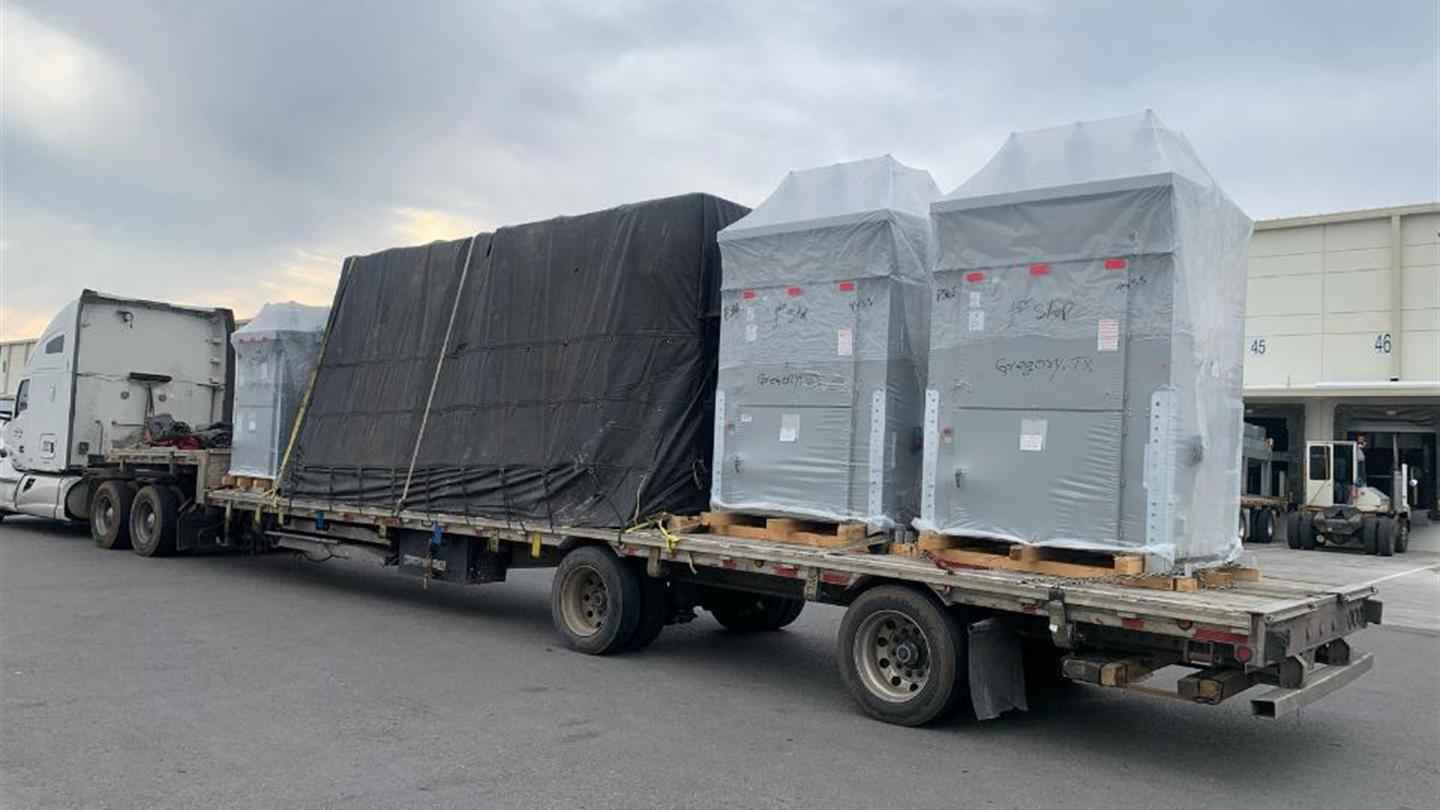
A plant ships several freight profiles in the same week, and each one picks its own trailer. Coils, plate, bar and long extrusion bundles ride flatbed or step deck because they are loaded by overhead crane and secured with cradles, timbers, chains and edge protection, not stacked through a dock door. Palletized finished goods, totes and racked components ride dry van, where a dry floor and sealing doors are the actual spec. Release quantities that do not fill a trailer go LTL when the part can take terminal handling, and partial truckload when it cannot, because every transfer is another forklift near a painted panel or a top-heavy rack. Several suppliers feeding one plant get cross-docked into one inbound so the plant burns one door slot instead of five. Team drivers keep a build-critical trailer rolling overnight, and a station already down gets urgent equipment on the nearest qualified truck. The unload method at the receiving end decides as much as the freight does: a plant that unloads with an overhead crane and a plant that unloads at a dock are not asking for the same truck.
Get a Free, No-Obligation Quote Today
A logistics specialist reviews your lanes and comes back with pricing and capacity. Support runs 24/7.
Every carrier is vetted for operating authority and insurance, and we check the certificate before every dispatch, not once a year. USDOT 3411782 · MC 1100274