In short
Aerospace and defense freight carries the strictest documentary traceability of any cargo on the road. Every serialized part travels with a package that proves where the material came from, who processed it and in what condition it left, and receiving inspection matches that package against the physical part before anything reaches a stockroom. A part with no paper cannot be installed even when it measures perfect. On top of that sit values in five and six figures per unit, near zero tolerance for shock, structures that are long and light at the same time, export rules that decide who is even allowed to carry the box, and a date set by a hangar or an assembly line rather than by anyone's convenience.
The Documentation Package Is Half the Shipment
Aerospace is the one cargo where paperwork can scrap a good part. A serialized component travels with a certificate of conformance from the manufacturer, material certifications tracing raw stock back to a mill heat or lot number, process certifications covering heat treat, plating and non-destructive inspection, and, on an airworthy part, an FAA Form 8130-3 or an EASA Form 1. Receiving inspection matches serial and lot numbers against that package. If the package is incomplete, the part goes to a quarantine cage instead of to the line.
That is why a lost envelope is not a clerical problem. A machined fitting with no traceable history cannot be installed on an aircraft even when it measures perfect, and rebuilding the history means going back to the supplier for reissued certifications, or scrapping a long lead time part when the process house that made it no longer runs that approval. So the documents ride in a sealed, weatherproof sleeve fixed to the crate rather than loose in a driver's pouch, the packing list is photographed at loading, and serial or lot numbers are written onto the bill of lading so the metal and the paper stay tied together through every handoff.
Defense tenders add a second layer of fields that come from your program office and never from a carrier: the transportation control number in its fixed format, the line of accounting, the issue and shipping document that governs the move, and a signature chain that has to stay unbroken from origin to the receiving activity. A receipt that cannot be posted against the right control number is an open shipment in your program's system long after the truck has gone. We ask for those fields up front and confirm the receiving site's hours, gate procedure and badging requirement before dispatch, because a truck that reaches a controlled gate without a name on the access list does not arrive late, it turns around.
Shock, Vibration and the Damage Nobody Can See
This hardware is built to tolerances measured in thousandths and inspected against them. A machined titanium fitting that takes a hard set-down can pass a visual inspection and still be out of tolerance. A composite panel can absorb an impact that barely marks the surface while delaminating plies underneath, which is why barely visible impact damage has its own name in this industry and its own inspection procedure. Nobody at receiving guesses. The part goes to non-destructive inspection, and your build slot moves while it sits there.
So the shipment gets instrumented, and the instruments belong to the packaging specification rather than to the truck. Your packaging group sets the threshold on the impact and tilt indicators, and on high value assemblies adds a data-logging recorder that timestamps every event above that level. The threshold is set to what the crate was designed to absorb, so a tripped indicator does not mean the part is broken, it means the package worked at its limit and the part now owes an inspection. The record cuts the other way too. A clean trace is what releases an assembly into stock instead of into a quarantine cage while somebody spends a week proving a negative. Tell us who owns the instruments and what the thresholds are, and the handling brief is written to them.
Prevention is equipment and restraint. Air-ride under a crate whose cushioning cannot be rebuilt mid-lane, blocking and bracing so the load has nowhere to travel, and securement to FMCSA standards taken at the frame's designed lift and lash points, never across a machined datum surface or over the contour of a panel, because a strap pulled down on a cradle anywhere but its hardpoints is how a skin gets pressed out of shape. Then no terminal re-handling, because every extra forklift near that crate is another chance to trip an indicator and start the inspection cycle that the packaging was bought to avoid.
The trailer itself is part of the specification. Bare machined aluminum and unfinished steel corrode from condensation when a lane swings from a cold night into a humid morning, so parts ride in vapor corrosion inhibitor film with desiccant inside a sealed barrier and stay sealed until they are inside the plant. Avionics and line replaceable units travel in static shielding bags that nobody opens on a dock to look at. Foreign object debris control does not stop at the factory door either: a swept trailer, no loose hardware, no residue from the previous load and no packaging that sheds, because a stray screw that migrates into an open assembly is a far bigger problem than the freight bill.

Long, Light, and the Reason It Will Not Fit
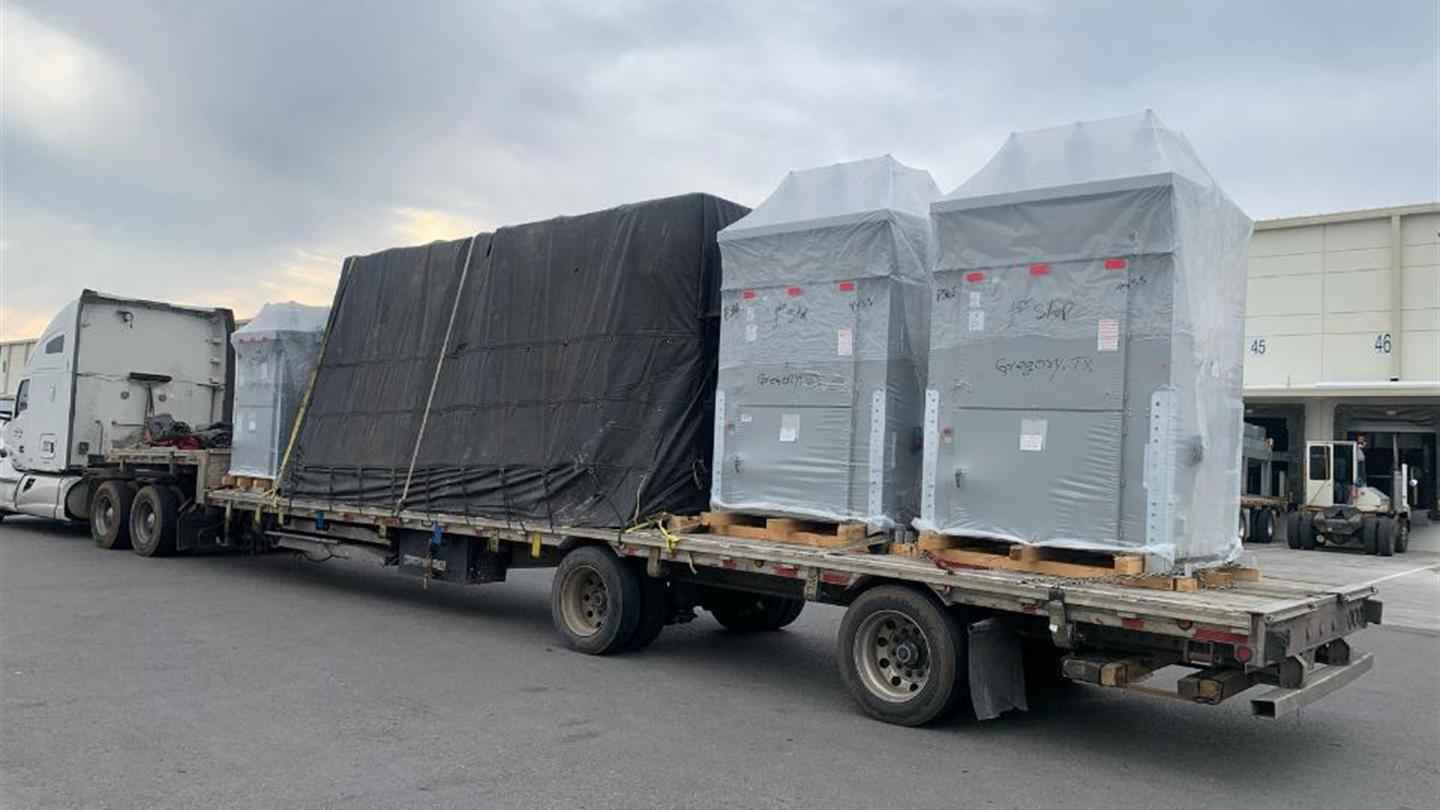
Structural aerospace parts break the usual relationship between weight and difficulty. A spar, a stringer set, a floor beam or a fuselage panel can run past forty feet and weigh less than a pallet of packaged goods. The trailer runs out of length long before it runs out of payload, and the part almost always travels inside a steel shipping frame or a contoured cradle that is taller and wider than the part itself, because the frame is what holds the contour. Quote the frame's outside envelope, never the part's, because the frame is what has to clear.
That envelope decides the equipment instead of the weight. A long crate still inside legal dimensions rides enclosed in a fifty-three foot van, which is what a finished aerostructure should get whenever it fits, and partial truckload keeps it there without a terminal in the middle. Past legal length or width the move becomes an over-dimension permitted load, and a plant relocation, a test rig or a multi-piece program move becomes project cargo. Those are modes, and they have their own pages: what belongs on this one is which aerospace parts end up in them and why. Tooling inverts the problem: an assembly jig or a mold tool is rigid, heavy and dimensionally critical, and a fixture that racks or twists in transit has to be re-certified before it is allowed to hold a part again, so deck height is chosen to keep it legal and it is secured at its designed lift points rather than across a locating surface.
Engines carry their own answer. They ship in a manufacturer's transport container or on an engine stand, and that container is the packaging spec, the handling instruction and the tie-down plan in one document. It is built to be lifted and lashed at defined points, it often carries its own environmental seal and shock instrumentation, and it needs a deck height and clearance that let it ride as designed instead of being forced onto the wrong trailer. Ground support equipment behaves like the wheeled and skidded machinery it is, which makes it the simplest thing on an aerospace program to move and the reason the same account has to reach both ends of the equipment range.
The Clock Belongs to a Hangar or an Assembly Line
Nothing here ships to a date somebody picked for convenience. Either an aircraft is on the ground waiting for a part, where every hour burns revenue and cascades through a flight schedule, or a component is kitted to a station date on a line whose takt time is fixed and whose next operation cannot start without it. Both clocks were running before the freight was ever tendered.
An AOG move is a different service from a fast move. It runs exclusive use so the trailer never stops for anyone else's freight, it runs team drivers when the distance is more than one driver's hours of service can cover in a single push, and the decision gets made in hours. Urgent transport is a defined service here with 24/7 coverage behind it, and the specialist on your account makes that call instead of a queue. The detail that actually decides an overnight AOG is not the miles, it is whether the receiving station can physically take the part at three in the morning and who at that gate is authorized to sign.
Scheduled program freight is the opposite discipline and has to be treated that way. A part delivered three days early to a plant with no floor space sits outside on a dock absorbing weather its packaging was meant to survive once, and on frozen material every one of those hours is drawn out of the roll's out-time budget. A repair and return unit that misses its MRO induction slot hands that slot to the next aircraft in the shop and waits for the schedule to open again. So the plan is built backward from the station date or the induction date, with receiving hours, gate procedure and dock capability confirmed before pickup.
Export Control, Clearances and Sector Certifications: Ask Before You Tender
This is the part of aerospace and defense freight that has nothing to do with trucks. If your item is a defense article on the United States Munitions List, the export side is governed by ITAR, and the parties that export or broker it have to be registered and operating under a license or a written exemption. If it is a dual use item on the Commerce Control List, EAR licensing applies instead, and the classification of the part decides which regime you are in. Classified material is stricter again: it moves only through cleared facilities and cleared personnel under the National Industrial Security Program. A Department of Defense move of arms, ammunition and explosives, or of other protected cargo, can require a carrier approved for Transportation Protective Services at a named surveillance level, with an unbroken custody chain the whole way.
Quality flows down separately. Aerospace buyers commonly push AS9100 requirements through their supply chain, some flow down C-TPAT or specific security expectations onto cross-border legs, and each of those is a status a company either holds or does not. There is no partial credit and no good faith version of a registration, which is exactly why this is the one qualification question worth asking before price.
So the honest answer is a process, not a claim. Tell us the export classification of the part, whether the shipment is controlled, and exactly which registrations, clearances or certifications your contract flows down to the transportation provider. You get a written answer for that specific tender before anything is booked, and where a requirement is one we do not hold, you get told so up front instead of at a gate. Do not accept a vague yes on this question from any transportation partner, this one included. Get it named, in writing, per shipment.
Why Dobie Fits an Aerospace and Defense Program
Dobie coordinates transportation: a vetted carrier network managed by dedicated logistics specialists. On cargo worth this much per unit, that verification model is the point. The carrier assigned to your shipment is verified the day it is assigned, not once a year on a file review: operating authority in force, cargo insurance current with limits that correspond to what is actually in the crate, and equipment that corresponds to the assignment. A landing gear assembly and a pallet of shop consumables do not warrant the same cargo limit, and checking that on dispatch day is what keeps a serialized assembly off a truck whose coverage lapsed in March. The cargo travels covered by the carrier's cargo insurance, with condition documented at pickup and at delivery, which is the record the conversation runs on when an indicator trips and your quality group has to make a disposition.
Equipment range is the second reason, and an aerospace program is the case that needs all of it inside one month: enclosed dry van for finished detail parts, white glove for avionics and interiors that get placed rather than dropped, partial truckload for a crate that must never see a terminal, team drivers and urgent service for AOG, refrigerated equipment for prepreg and film adhesive, and flatbed, step deck, oversized and project cargo for tooling, ground support equipment and structures that will never fit a van. One account, one dedicated specialist, a nationwide network of verified carriers to draw the right one from across the 50 states, and a 98% on-time record behind the dates that a station slot depends on.
The Rio Grande Valley base matters because aerospace manufacturing and component repair sit on both sides of this border, with clusters in Querétaro, Chihuahua, Sonora and Baja California feeding North American programs, and a certified part crossing a border is where the schedule and the paperwork break at the same time. Crossings, customs brokers, maneuvering yards and Mexican carriers are weekly business for this team in the South Texas corridor, so the border sits inside your plan instead of ambushing it. There is also an internal team here for freight that is neither vehicles nor machinery, with experience in refrigerated, food and hazardous materials, which covers the two aerospace shipments that are not ordinary dry freight: frozen prepreg running against an out-time budget, and the regulated articles an aircraft program ships by design, from lithium batteries and chemical oxygen generators to compressed gas cylinders, paints and sealants.